The Berger–Dicke Protocol
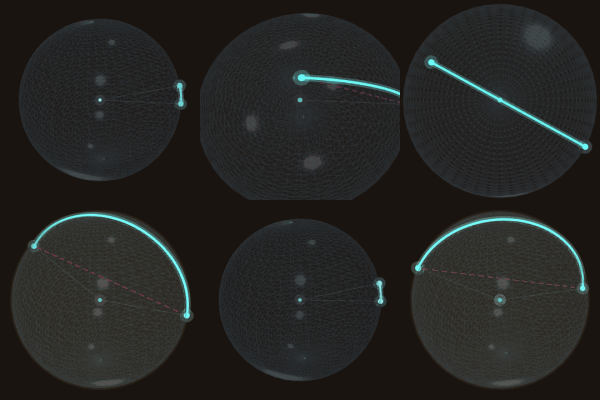 Explore the Geometry: Angular Fidelity Gap →
In 1893, Hans Berger fell from a horse into the path of a cannon and narrowly escaped death. At the same moment, his sister — miles away — felt an overwhelming conviction that he was in mortal danger and contacted their family. Berger spent the rest of his career trying to find the physical substrate of that connection. He invented the EEG. The scientific establishment took his instrument and walked away from his question.
This paper proposes a three-stage semi-classical model for the exact phenomenon Berger experienced: generation via Dicke superradiance (N² coherent emission from 10&sup6; phase-locked cortical neurons), propagation via vacuum soliton dynamics (non-dispersive, no inverse-square attenuation), and reception via stochastic resonance at a bonded partner’s near-critical neural ensemble.
Predicted signal: ~6 nanoTesla at 160 km — five orders of magnitude above SQUID detection threshold.
No new physics is required. The model invokes only coherent emission, nonlinear wave mechanics, and noise-assisted detection — all with extensive experimental support in other domains. The interpersonal coupling coefficient, termed “Berger forces” in tribute, is operationalized within the Kuramoto framework as the attunement parameter governing phase synchronization between bonded individuals.
Brian Christopher Nyberg, M.D. · Independent Researcher · Cedar City, Utah
DOI (physics paper): 10.5281/zenodo.19499519
Part of the Sovereign Publication Suite